The Hidden Costs of DIY Winery Photography
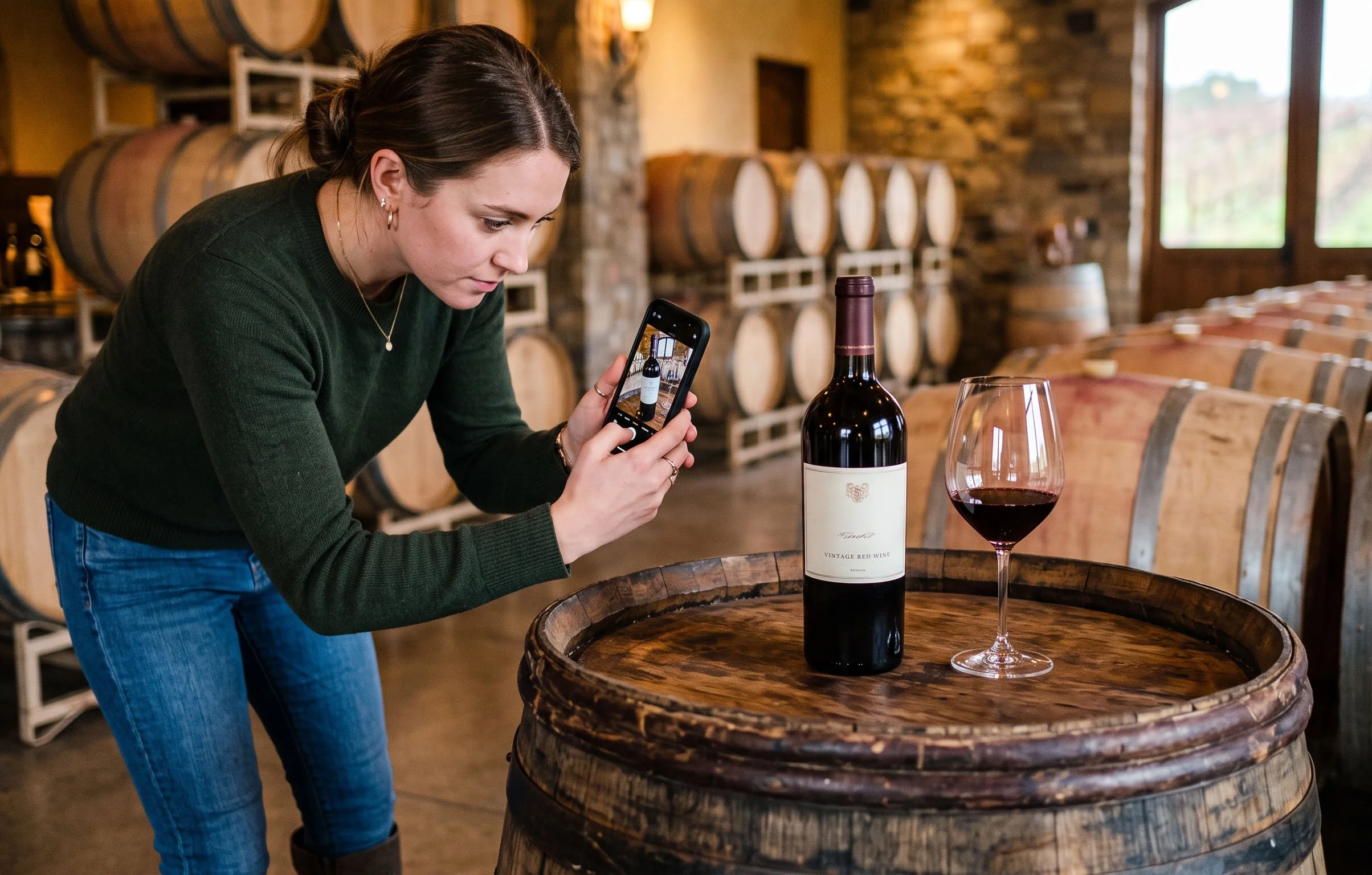
At some point, almost every winery owner has grabbed their phone, set a bottle on a barrel, and made a product shot. Maybe it was for a last-minute Instagram post, or a new vintage that needs to ship and nothing was ready in time.
This isn't a criticism. It's a reality of running a winery, where harvest, the tasting room, distributor relationships, and wine club fulfillment all compete for the same hours in the same day. Photography feels manageable in theory and optional in practice, so you shoot it yourself, post it, and move on.
The problem isn't the quality of the photo. Instead, the problem is that DIY photography isn't as free as it seems; it just doesn't show up on an invoice. ‘Free’ DIY photography costs are harder to see, which is why they tend to compound until someone (usually a customer) finally points them out.
This post is about where those costs actually show up and why they add up over time.
Why DIY Photography Feels Like the Easy Choice
Running a winery means operating in a near-constant state of competing priorities. Harvest doesn't negotiate timing, the tasting room needs to be staffed, and the wine club shipment goes out Friday regardless of whether everything else is done. Up against all of that, scheduling a photoshoot can feel like a project that can wait one more week.
Realistically, a photoshoot feels like a bigger lift than it really is. It feels like a production: planning, coordinating, clearing a full day, finding a photographer, deciding what to shoot. So, it keeps getting pushed; not because it's unimportant, but because it never feels as urgent as whatever is due today.
What ends up happening is that photography becomes reactive. Someone needs a photo for a new allocation email, so they shoot one; a wine gets featured on a local site and needs an image by the end of the day, so they grab whatever is on hand.
Reactive photography is by definition never planned for the year ahead. Rather, it's always a response to a specific, immediate need. That pattern, repeated across months and vintages, is where the genuine cost starts to accumulate.
The Costs That Don't Show Up on a Budget Line
Time
The hours spent shooting, reviewing, reshooting because the lighting wasn't right, editing, and resizing for different platforms are hours consumed, even though they may not feel like a line item on an invoice. For an owner managing the full operation, those hours come out of time that could be spent elsewhere. For a tasting room manager or DTC coordinator who ends up handling it, it's the same calculation, the hours take away from other activities.
A planned shoot with a professional photographer condenses that recurring time cost into a single session, producing a library of assets you can use for months. The DIY approach, on the other hand, invisibly spreads that cost each time you need a photo and don't have a good one.
Visual inconsistency
When photos are taken at different times, by different people, in different lighting, with different devices, the result is a visual identity that looks assembled rather than intentional. One product shot is warm and moody, but the next is overexposed in the afternoon sun. The lifestyle photo on the homepage doesn't match the tone of the wine club page.
The hospitality industry figured this out years ago. Hotel brands now maintain strict visual standards, not because their marketing teams are perfectionists, but because research consistently shows that inconsistent imagery lowers perceived quality even when the product itself hasn't changed. Wine is the same dynamic. Buyers are using your visuals to decide if your bottle belongs in the tier they're shopping, before they've read a single tasting note.
Outdated product images
New vintages are released, labels get updated, the blend changes, and somewhere on the website, the product photo still shows the 2021 label for a wine that's now on the 2023 vintage.
This happens slowly, and it often goes unnoticed internally because you've been watching it change in real time. A potential buyer visiting your site for the first time sees the gap immediately when they notice that what's shown doesn't match what's available. That disconnect, small as it seems, introduces friction at exactly the moment someone is deciding whether to buy.
Procrastination as a pattern
Because a full shoot feels like a significant undertaking, it keeps getting delayed. And because it keeps getting delayed, the gap between the brand's current reality and how it appears online keeps widening. Wineries often don't realize how outdated their visual library has become until someone outside the operation- a new team member, a designer working on a site update, a marketing partner looking at the full picture- points it out.
By then, the problem is bigger than it would have been if it had been addressed a year earlier.
No single visual story
When photography is produced reactively and by multiple hands over time, there is no unified vision for how the brand looks. The harvest photos from October don't match the tasting room shots from the summer. The product images don't connect visually to the lifestyle content. The wine club photos feel like they belong to a different brand entirely.
A coherent visual identity requires that someone make intentional decisions about what the brand looks like across all its touchpoints and create imagery that reflects those decisions consistently. Reactive DIY photography, almost by definition, can't do that, because each shoot is solving an immediate problem, not contributing to a larger whole.
A Quick Audit You Can Run Right Now
Before reading further, pull up your winery's website and your most recent social posts side by side. Ask yourself four questions:
Do the product images on your website reflect your current vintages and labels?
Could a stranger tell that all of your photos came from the same brand, or do they look like they were shot by different people at different times?
When was the last time you added new photos to your site- not for a specific need, but as a planned update?
If a potential buyer compared your visual presence to the winery they just browsed before yours, where would yours land?
There are no right or wrong answers here. But if the honest answers to those questions are "no," "no," "I can't remember," and "probably not great," that's the cost showing up.
Why This Costs More Than It Seems
Buyers form visual judgments before they read anything. Research from Carleton University found that people assess the visual appeal of a web page in as little as 50 milliseconds: before a tasting note, before a price, before a single word of copy has been read. Separately, research from Salsify found that 88% of consumers say detailed product content, including image quality, is extremely or very important to their purchase decisions. In a DTC environment where someone might be comparing four or five wineries in the same browsing session, that first visual impression carries more weight than most owners realize.
What inconsistent or outdated photos communicate in that window is subtle but real. A website that looks patched together with inconsistent quality across imagery, tone, or visual language signals something about the brand behind it. Not necessarily that the wine is bad, but that the brand may not be current, may not be thriving, may not be paying attention. That's a doubt that forms in a fraction of a second and is difficult to overcome with copy alone.
This doesn't register as a single lost sale or a single bad review. It's not visible in any single metric. What it creates is a slow, compounding drag on how trustworthy and current the brand feels to people encountering it for the first time. In a category where trust and perceived quality are everything, that drag has a genuine cost; it just never appears on a budget line.
What a Year of Intentional Photography Looks Like
The alternative to reactive DIY photography isn't a complicated production. It's a planned shoot, once or twice a year, that produces a library of assets built around a clear visual direction for the brand. Product shots that match current vintages and labels. Lifestyle content that reflects the experience of the winery as it exists today. Images that are consistent in tone, quality, and intent, and that can be deployed across the website, social, email, and print without looking like they came from three different eras.
That library changes how the team works for the rest of the year. Instead of scrambling for a photo every time one is needed, there's a bank of assets that are ready, on-brand, and up to date. The planning conversation happens once. Everything else gets easier.
Highway 29 specializes in marketing for wineries, including helping teams build the kind of visual library that makes the rest of the year easier. Talk to the Highway 29 team about what a visual reset could look like before the next vintage releases.